
We’re probably going to look back on the last few years as The Great Productivity Mirage.
The reality is that remote and hybrid working has created a digital screen that employees can hide behind. In fact, it’s even possible to hide behind the digital screen when working from the office.
We have the Slack green light phenomenon and similar indicators on other messaging and collaboration tools. The light is on, the indicator is green, the toggle is active… but are they really working? The lights, indicators, and toggles don’t give any insight into what employees are actually doing.
They are an app activity indicator, not a work activity indicator.
As for mouse-jigglers, there is a whole industry that has sprung up to help employees look like they are working when what they are really doing is quiet quitting or working a second job on your time!
The High Cost of Employees Looking Busy
Employees looking busy when they are not hits the bottom line – it’s an EBITDA drain. Try this for a calculation: if 10% of your workforce is operating at 50% capacity (because they are disengaged or distracted), how much are you losing every year? There are probably lots of zeros on that number.
The problem isn’t just employees, either, as management is often also an issue. It is more common than not for companies to drift into what can be described as a vibe-based management trap.
“Vibing” is getting a lot of good vibes in business at the moment, with vibe coding being the best example.
In management, however, a vibe-based style hides huge productivity gaps. How quickly an employee responds to emails or a manager’s gut feeling on whether workers look busy or not tells you very little about what is really going on.
What you actually need is deep, accurate, real-world data.
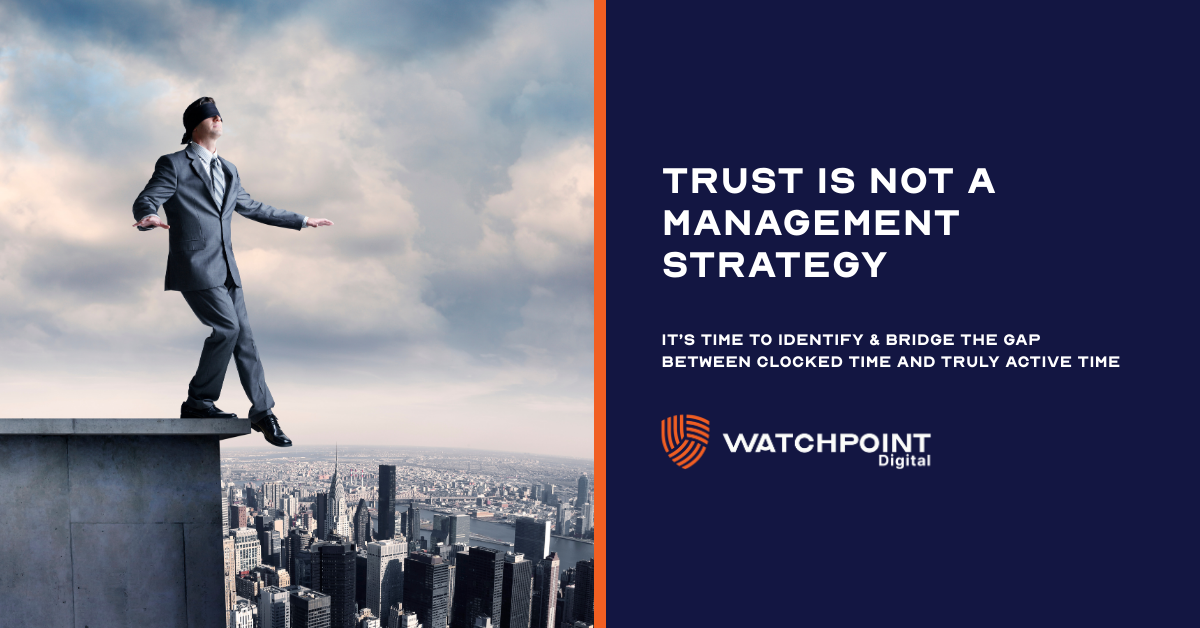
This is what we do at WatchPoint – we’ll help you identify and bridge the gap between clocked time and truly active (rather than green light, jiggly mouse) time.
Defining Resource Integrity
Resource integrity is the alignment between a company’s investment in labor and the output that labor produces.
Defining it is one thing, but achieving resource integrity is another, especially when there is an absence of data.
On the flip side, with data, you will have all the information you need to identify where there are issues and take action when necessary:
- Application usage – are employees using Excel or Etsy, PowerPoint or Pinterest, ServiceNow or Snapchat?
- Active time or idle time – are employees really working when they should be working?
- Engagement signals – identifying drift indicators before a valued employee disengages.
Resource Integrity, Not Micromanagement
It’s important at this point to address the elephant in the room in relation to workplace monitoring software. The accusation is that it is about micromanagement, a Big Brother attempt to optimize productivity.
It can be used that way, but that’s not the way it is most effective. In fact, you can damage productivity if you take a Big Brother approach.
And while it’s important to address the elephant in the room, it’s also important to properly push back on the ethical questions about workplace monitoring software. Let’s go back to the calculation we highlighted earlier, where 10% of your workforce is operating at 50% capacity. What this actually means is that your high performers are carrying the cheats and slackers. Looking at workplace monitoring software from this perspective, it’s about meritocracy rather than micromanagement.
The bottom line is that workplace monitoring software is best used (and achieves the most transformative results) when the focus is on optimizing workflows and removing bottlenecks, not catching people out.
Meritocracy Requires Data: Shining a Light on Your Enterprise
Without data, enterprises are largely managing and optimizing productivity in the dark. With this reality, it’s easy to see where to find the competitive edge – it’s with the organizations that know exactly how things are running. Not based on hunches, gut feelings, and observations, but based on data.
You wouldn’t trust a hedge fund manager to trade hundreds of millions in capital based on vibes, the appearance of working hard, and gut feelings. You would want them to use data, deep analytics, and thorough risk metrics.
The same should apply when running an enterprise – productivity analysis should be based on data, not trust.