
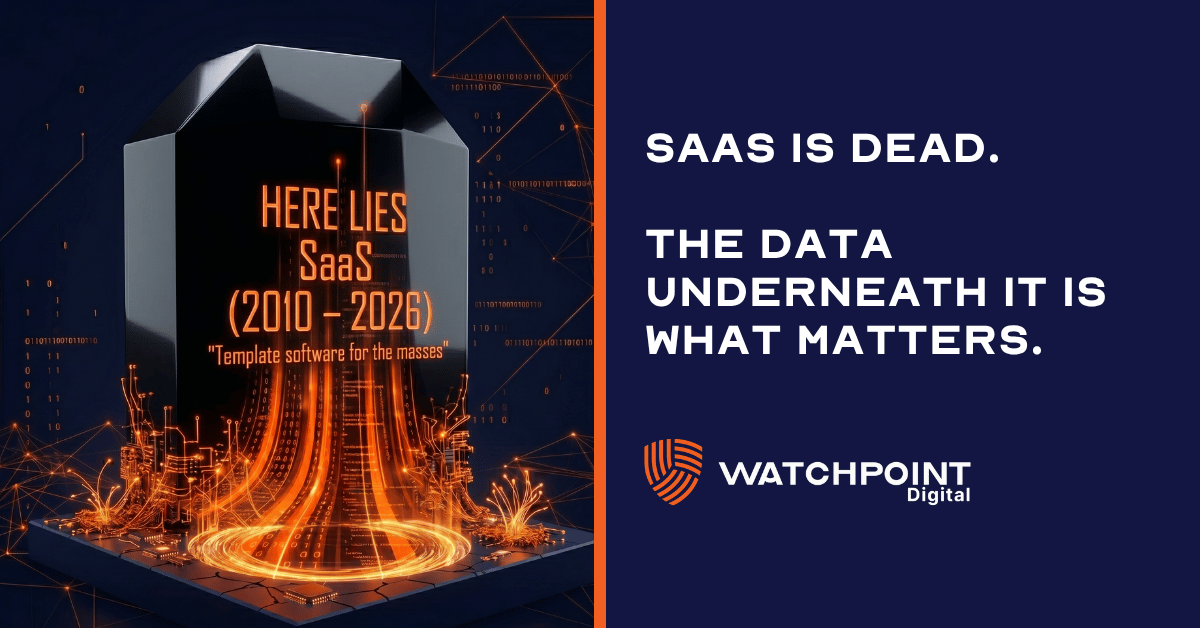
Palantir deployment strategist Danny Lukus recently put it bluntly: “SaaS is dead.” His argument was sharper than the headline. Template software forces companies into workarounds. It strips competitive differentiation. Anything built for one customer becomes available to that customer’s competitors in the next release.
The point lands. And it applies directly to workforce intelligence.
The Wrong Shape for the Work
A typical workforce SaaS product is a multi-tenant dashboard. Limited telemetry. Generic schema. Vendor cloud. Shared data model. Shared roadmap. Any insight one customer derives is structurally available to every other customer running the same product.
That shape worked when the goal was a quarterly headcount report. It does not work when the goal is making sharper people decisions than the firm across the table.
Three problems sit at the core. Workforce SaaS lacks depth: login counts are not behavioral signal. It lacks specificity: a generic schema cannot model how one specific business actually runs. And it lacks ownership: data parked in a vendor cloud is hard to combine with the rest of the firm’s proprietary data without friction.
What WatchPoint Is Instead
WatchPoint is not a workforce SaaS tool. It is a non-SaaS telemetry layer that integrates directly into the customer’s business.
The patent-pending integration captures application activity, engagement patterns, attendance signals, behavioral indicators, and productivity distribution. The data lives inside the customer’s environment. The insights stay there. No shared multi-tenant database. No vendor extraction. Customers retain ownership of all telemetry and all derived insights.
This is the architectural distinction Palantir is pointing at, applied to workforce data. WatchPoint is not another tool sitting alongside the SaaS stack. It is the underlying data layer that makes everything sitting on top of it work better.
What You Get
The capability stack maps to what JPMorgan and Morgan Stanley spent years and tens of millions of dollars building internally:
- Productivity distribution analysis. Bell-curve benchmarking that surfaces underutilization and excellence.
- Frozen middle identification. Managerial bottlenecks, made visible.
- Remote work efficacy. Defensible answers to return-to-office questions, grounded in data instead of anecdote.
- Overemployment detection. Workforce anomalies surfaced before they become incidents.
- Resource and vendor tracking. Allocation, spending, and output across internal teams and external partners, with no blind spots.
One Agent, Not Five
Most large enterprises run a fragmented endpoint stack: a DEX agent, log forwarders, data agents, automation software, a productivity tool layered on top. Each consumes resources. Each produces a partial view that has to be manually reconciled.
WatchPoint replaces the stack with one solution. Technical telemetry and behavioral metrics in the same agent. One data model. One source of truth. Lower endpoint overhead. Reduced licensing spend. Faster time-to-insight.
Bottom Line
The dashboards are commoditized. The seats are commoditized. What is not commoditized is the depth, ownership, and organizational specificity of the underlying telemetry. That layer is what separates firms making sharper decisions from firms guessing better.
WatchPoint is that layer.
See what an owned workforce telemetry layer looks like in your environment. Get started with WatchPoint.