

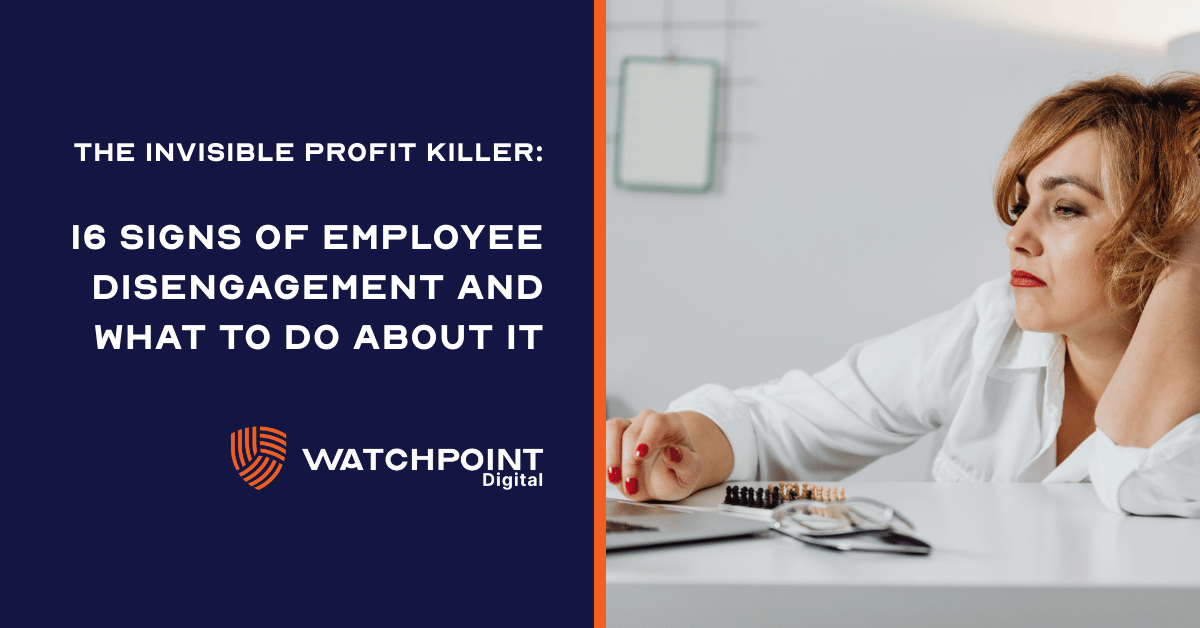
According to research by Gallup, only 21 percent of employees around the globe are engaged. That’s about one in five employees who feel connected to their job and employer. All the rest are working at some level of disengagement.
This is tanking your profits.
Levels of disengagement can vary, of course, but the productivity costs alone are undeniable.
How do you fix it?
The starting point is to understand employee disengagement and its causes. From there, you can put in place a plan to deal with the issue.
We address the above points in this blog, but there is an important element to highlight first. Dealing with employee disengagement is not a one-time process. Instead, it should be an ongoing, data-driven, automated, strategic priority.
What is Employee Disengagement?
Employee disengagement is a state of emotional and mental withdrawal from work, where employees feel disconnected. This could be disconnected from their job, team, organization, or all three.
Essentially, a disengaged employee has checked out. They typically do the minimum required, work quality drops, and there is a lack of initiative.
Disengaged employees are bad for your organization, but there is another level that is even worse – the actively disengaged employees.
Actively disengaged employees are more than unhappy or disconnected; they are resentful. They don’t just lack passion; they bring negativity.
Dealing with both – the disengaged and the actively disengaged – is essential, whether through re-engagement strategies or other options.
10 Signs of Employee Disengagement
- Decreasing productivity and drops in an employee’s quality of work, including missing deadlines. A rapid reduction in productivity and/or quality can be a sign of an actively disengaged employee.
- Low participation (especially in meetings) and social isolation (for example, not taking part in company social or team building activities).
- Absenteeism and lateness.
- Reduced collaboration with colleagues.
- Reluctance to provide feedback, either positive or negative (can demonstrate they don’t care either way).
- Low morale and a persistent negative attitude, such as a focus on things that don’t work and why, rather than how to fix things and make improvements.
- Lack of initiative, lack of enthusiasm, and/or frequent criticism of work activities (projects, initiatives, etc).
- Resistance to change, as well as those who actively resist change and push back on new initiatives. The latter are likely to be actively disengaged employees.
- No interest in professional development.
- Testing boundaries and disregarding policies, especially for employees who are actively disengaged.
A high staff turnover rate is a more generalized sign of a disengaged workforce rather than an employee-specific sign.
It can be hard enough to identify the above signs when looking at a small group of employees, let alone analyzing thousands across a large organization. Data, automation, and AI-powered analytics are the solution – see the What to Do About Employee Disengagement section below. But first, what are the causes?
Understanding the Causes of Employee Disengagement
- Poor role alignment where employees don’t understand where they fit in the organization. A lack of role clarity is a subset of this point, where employees don’t know what is expected of them.
- Employee burnout, often due to too much work.
- Not enough work can also cause disengagement, as employees can feel undervalued and demotivated.
- Change fatigue, where employees feel demotivated by workplace transformation. AI technologies, in particular, can cause anxiety that leads to disengagement.
- Limited flexibility in areas such as when and where employees work, as well as how tasks are completed or projects tackled.
- Poor quality leadership, especially if managers are also disengaged. Employees feeling disconnected from their managers can also lead to disengagement.
- Lack of recognition for what the employee does at work.
- Limited growth and career development opportunities.
What to Do About Employee Disengagement
Step 1: Identify Disengaged Employees
Surveys and manager observations have a role to play when identifying disengaged employees, but data-driven insights are the more reliable method. You can get this data with workplace monitoring software.
Step 2: Communicate With Disengaged Employees
Discuss the disengagement signs, backed up by data, with employees on a 1:1 basis.
Step 3: Address the Causes of Disengagement
Address the causes of disengagement as much as possible. Provide clarity on role expectations and alignment, for example, or address workload imbalances. Providing career development opportunities, offering greater flexibility, and empowering employees are other examples.
Step 4: Review Your Wider Company Culture
At a macro level, it is beneficial to look at improvements that might reduce the risk of employees becoming disengaged in the future. Reviewing your company culture is a good place to start. Improving communication is often a central component, as is fostering a positive work environment.
Step 5: Track Re-Engagement
Significant work will have taken place by this stage to re-engage employees. It’s therefore important to track progress to ensure your re-engagement efforts are working and to identify further areas for improvement. Regular employee surveys help with tracking re-engagement, but it is also essential to use the data and insights available through workplace monitoring software.
Identifying Disengaged Employees with WatchPoint Digital
At WatchPoint Digital, we can give you the capability to identify disengaged employees. We do this through our workplace monitoring software that unlocks the data you already have so you can identify the disengagement signs in the list above. You can then target your re-engagement efforts where they will have the most impact on performance and profit margins. Get in touch to arrange a consultation.